You’re Not Lazy. You’re Depleted.
A New Framework for Rebuilding Motivation From Within
There’s a moment many high-performers don’t talk about.
You wake up… and the drive just isn’t there.
The same person who used to execute relentlessly, lead boldly, and push through anything—now feels stuck, foggy, and unmotivated.
And the immediate instinct?
👉 “What’s wrong with me?” 👉 “Why can’t I just get it together?” 👉 “I need more discipline.”
But what if the problem isn’t discipline at all?
What if the problem is depletion?
The Science: Motivation Is Not a Personality Trait
Motivation is not something you have or don’t have. It’s a state—one that is deeply influenced by your psychological and physiological resources.
According to Self-Determination Theory (Deci & Ryan, 2000), sustainable motivation is driven by three core needs:
Autonomy (feeling in control of your choices)
Competence (feeling capable and effective)
Relatedness (feeling connected to others)
When these are unmet, motivation doesn’t disappear because you’re weak—it disappears because your system is protecting you.
Add to this the concept of ego depletion (Baumeister et al.), where prolonged decision-making, stress, and emotional regulation drain your cognitive energy—and suddenly, your “lack of motivation” starts to make sense.
You’re not broken.
You’re running on empty.
Step One: Give Yourself Grace (This Is Not Soft—It’s Strategic)
High performers often resist self-compassion because it feels like letting themselves off the hook.
But research by Dr. Kristin Neff shows that self-compassion is strongly linked to:
Greater resilience
Higher emotional regulation
Increased motivation—not less
Why?
Because shame shuts down action. Grace creates safety—and safety allows you to re-engage.
Instead of:
“I’m failing. I need to do better.”
Try:
“I’m human. Something in my system needs attention.”
That shift alone begins to rewire your internal environment.
Step Two: Rewire the Narrative (Cognitive Reframing)
Your thoughts are not neutral—they are instructions to your nervous system.
From a Cognitive Behavioral Therapy (CBT) perspective, unhelpful thought patterns (e.g., “I’ll never get back to where I was”) create emotional states like anxiety, helplessness, and avoidance.
To rebuild motivation, you must challenge and replace these narratives:
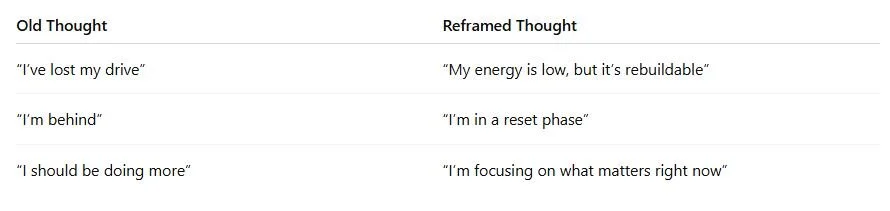
This isn’t toxic positivity.
It’s neuroplasticity in action—the brain’s ability to reorganize itself through repeated thought patterns.
What you think consistently becomes what you believe. What you believe determines how you act.
Step Three: Pour Into Yourself Before You Pour Out
We live in a culture that glorifies output.
But motivation is not created through pressure—it’s created through restoration.
From a neuroscience perspective:
Chronic stress elevates cortisol, impairing focus and drive
Rest and recovery activate the parasympathetic nervous system, enabling clarity and engagement
If you want your motivation back, you don’t start by doing more.
You start by rebuilding capacity.
That might look like:
Protecting your sleep like it’s a business asset
Moving your body—not for performance, but for regulation
Spending time in environments that restore you (nature, stillness, connection)
Reducing cognitive overload (fewer decisions, fewer inputs)
This is not indulgence.
This is system repair.
Step Four: Shrink the Action (Behavioral Activation)
When motivation is low, waiting to “feel ready” is a trap.
Instead, use Behavioral Activation—a clinically proven approach used in treating depression.
The principle is simple:
👉 Action creates motivation—not the other way around.
But the key is to make the action small enough to start.
Not “write the full proposal” → open the document
Not “work out for an hour” → go for a 10-minute walk
Not “fix everything” → complete one meaningful task
Each small action sends a signal:
“I am capable. I am moving.”
And that builds momentum.
Step Five: Redefine Motivation
Here’s the truth no one tells you:
Motivation is not about feeling inspired.
It’s about being aligned.
Aligned with:
Your values
Your energy
Your current season
Sometimes, what looks like “lack of motivation” is actually misalignment.
You’ve outgrown something. You’re exhausted from something. Or you’re being pulled toward something new.
And your system is asking you to pause long enough to notice.
This Is Not the End of Your Drive—It’s the Evolution of It
The version of you that operated on pressure, urgency, and constant output?
That person got you here.
But they may not be the version that gets you where you’re going next.
This season—this pause, this lack of motivation—is not a failure.
It’s an invitation.
To rebuild yourself with:
More awareness
More sustainability
More intention
So instead of asking:
“How do I force myself to get motivated again?”
Ask:
“What does my system need to feel safe, energized, and aligned again?”
Because when you take care of that—
Motivation doesn’t have to be chased.
It returns.
References
Deci, E. L., & Ryan, R. M. (2000). The “what” and “why” of goal pursuits: Human needs and the self-determination of behavior. Psychological Inquiry, 11(4), 227–268.
Neff, K. D. (2003). Self-compassion: An alternative conceptualization of a healthy attitude toward oneself. Self and Identity, 2(2), 85–101.
Baumeister, R. F., et al. (1998). Ego depletion: Is the active self a limited resource? Journal of Personality and Social Psychology, 74(5), 1252–1265.
Beck, J. S. (2011). Cognitive Behavior Therapy: Basics and Beyond. Guilford Press.
Dimidjian, S., et al. (2006). Behavioral activation for depression. Journal of Consulting and Clinical Psychology, 74(4), 658–670.
If this resonated with you—or if you know someone who’s been feeling stuck, burnt out, or questioning themselves—share this with them.
Sometimes the most powerful thing we can do is remind each other that we’re not broken… we’re just human, and in need of recalibration.